
Star Trek Into Darkness
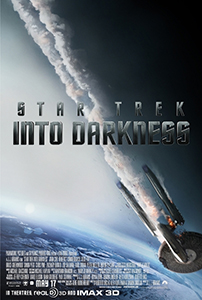 A valid criticism about the last Star Trek film was that it was too much like Star Wars with its emphasis on flashy special effects and high-octane action. This same critique is applicable to Star Trek Into Darkness, the latest entry in the long-running film series. But at least more of an attempt is made to make this film seem more like Star Trek.
How so? Concern is brought up on more than one occasion that Starfleet is becoming too militarized and that they should be explorers. By the end of the film, the main characters like Captain Kirk (Chris Pine) wholeheartedly embrace that concept based on their experiences throughout the film. In some ways, Star Trek Into Darkness is a battle for the soul of Star Trek and to try to go back to its roots. The film doesn't always succeed in getting that point across, since it wants to revel in the big-action scenes that define the J.J. Abrams era of Star Trek. In fact, it's best to think of this film as Abrams' audition tape for directing the next Star Wars film.
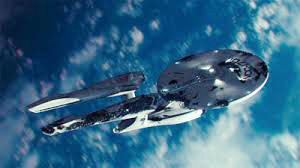
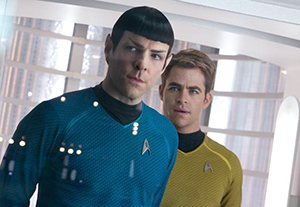 Star Trek Into Darkness is one of the most exciting films in the series thanks to J.J. Abrams' directing. In a nutshell, the film is about Kirk and the Enterprise crew tracking down a super-powered terrorist, that turns out to be Khan (Benedict Cumberbatch). But the real villain is someone higher up in Starfleet who wants to prepare for war against the Klingon Empire and goes as far as using Khan for his superior intellect to achieve this goal. Like its main character, the film is brash, bold and in your face with wild and intense action scenes. Highlights include a thrilling chase of Khan in San Francisco by Spock (Zachary Quinto) that culminates in a heart-pounding fight, where Spock nearly loses his control. Another is when a crippled Enterprise falls towards Earth, the special effects of those scenes are just brilliant and dazzling.
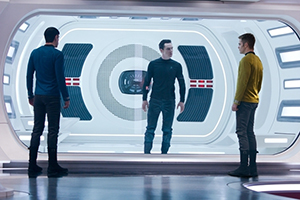 What should also be lauded are the magnificent settings. Seeing the futuristic cities like London and San Francisco are delightful. They look so real and plausible while being futuristic, and evoke the cityscapes seen in Blade Runner or Coruscant in the Star Wars prequels with all the flying vehicles and high tech. Only the cities are more pristine and inviting. Overall, an impression is made that our future could really look like what's on the screen.
What buttresses all the eye candy in the film are the characters. More attention is spent on developing them, especially Kirk. Chris Pine does a great job with him, and although he isn't William Shatner, his rendition of Kirk is admirable. He injects a wider range of emotions as Kirk begins to learn about humility, loss and his vulnerabilities. Quinto also does a first-rate job as Spock although he comes off at the beginning as too stoic and cold. His early scenes with Uhura (Zoe Saldana) are too much like bad high-school romances with pointless bickering. However, events by the end of the film do a lot to unnerve the Vulcan to the breaking point and he has just cause for nearly losing control of himself.
 What causes that loss of control has to do with some quibbles I have with the film. Star Trek Into Darkness goes overboard at times in recreating moments from Star Trek II: The Wrath Of Khan right down to the exact dialogue. A couple of times is an homage but a few more cries lack of originality. It just brings to light the fact that the screenwriters resorted to using Khan, Star Trek's greatest villain, and not be more original. It would've been acceptable if Khan wasn't revived but some other superman. That isn't anything against Cumberbatch. His Khan is a great lethal and cold villain but can't compare to Ricardo Montalban, who was more regal and charismatic. The new Khan has little resemblance to the original one, which is why a different villain would've been preferable.
This film gets high marks for being fun and visually spectacular, but at times it just goes a little over the top with its hectic pace. It's clearly not the traditional Star Trek but remember not all the episodes in the original TV show were about exploring and ideas. They had their fair share of action-oriented episodes, just call to mind Kirk's many fight scenes, including one against the original Khan.
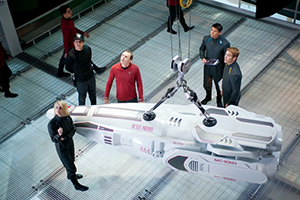
 Abrams and screenwriters Roberto Orci, Alex Kurtzman, and Damon Lindeloff should be saluted for paying more attention to Star Trek lore. There are many nods and tributes to all the Star Trek incarnations. Casual moviegoers won't spot them but core fans would. Some are utilizing Carol Marcus (Alice Eve) Kirk's lost love, showcasing models of the Phoenix and the NX-01 Enterprise, and the existence of the nefarious Section 31 from Star Trek: Deep Space Nine.
It's these little nuggets that make Star Trek Into Darkness a more enjoyable viewing experience than its predecessor. Is it too much like Star Wars? Yes, it is but the bottom line is that the film is an enjoyable romp and fans shouldn't worry too much about how off the mark Abrams' Star Trek films are in representing the franchise. Just note that Abrams and company won't be doing Star Trek forever; already he's to deservedly direct the next Star Wars film, something that better suits him. So we may get a new incarnation that better reflects what Star Trek is about. As stated earlier, there is a concerted effort by the film's end to put aside the rage and vengeance and begin exploring and striving to be better. That is the essence of Star Trek and it's great that this film finally began to recognize that. I can't wait to see what comes next.
José Soto